Posts Tagged ‘internet fun’

Internet Fun (Not So Funny)

Sunday, June 28th, 2009

I have no idea how true these emails I get are or whether their content has been published elsewhere but some stuff is worth sharing. That’s what I found today in my inbox:

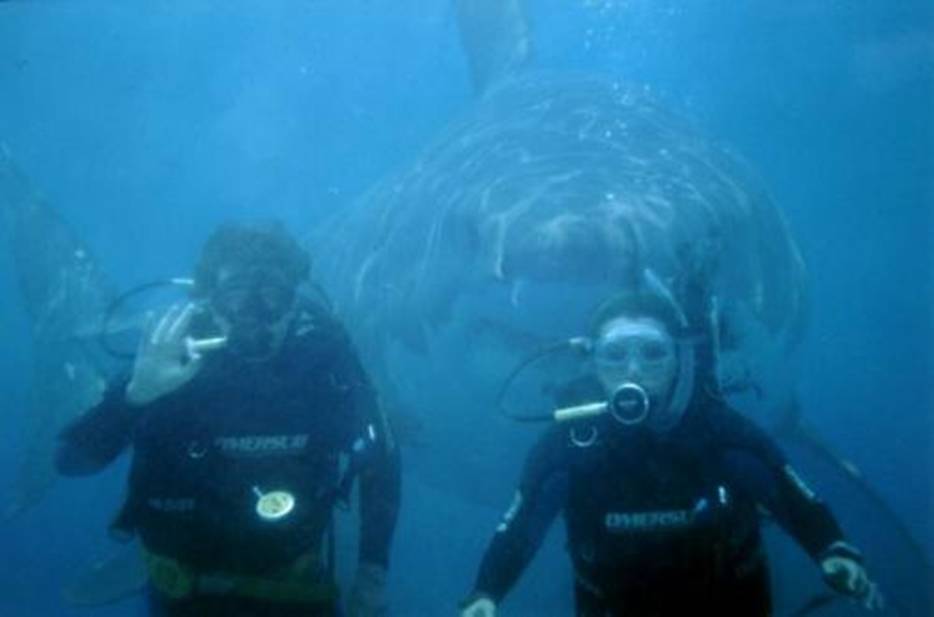
<< Family on holiday in Australia [...] when husband, wife and their 15 year old son decided to go scuba diving.[...] His son wanted a picture of his mum and dad in all their gear so he got the under water camera ready to go. When it came to taking the picture the dad realized that the son looked like he was panicking as he took it and gave the 'OK' hand sign to see if he was all right.


The son took the picture and swam to the surface and back to the boat as quick as he could so the mum and dad followed to see if he was OK. When they got back to him he was scrambling onto the boat and absolutely panicking. When the parents asked why he said 'there was a shark behind you.' The dad thought he was joking but the skipper of the boat said it was true but they wouldn't believe him. As soon as they got back to the hotel they loaded the picture onto the laptop and this is what they saw:

someshark

>>

How to Write a Blog (Featuring the Rule of Thumb for Blogging)

Wednesday, June 24th, 2009

I’m new to the so-called blogosphere. And I hate it. I never wanted my site to be confused with a blog (though now you can find it listed at blogcatalog.com – despite their early refusal to accept it). The mockoblog is to the blog what Terminator 2 is to the first animal + weapon + hunter scratched on a cave wall by our ancestors: no better, no worse thing, just so bloody different!

Blogs have been around for quite some time now, not as long as I have been, but long enough for me to not read them at all until I started to write the mockoblog.

I’ve been doing my homework and this is what I found:

  1. Blogs are stupidly boring and amazingly superficial.
  2. People write blogs because they have nothing to say but this silence of their mind sounds better when some audience is around.
  3. There was/is actually an older term for blog and that is the diary (journal), the only two problems with this one being that you normally need some paper and a quill and that you are supposed to keep it to yourself, tucked under your pillow at least for a while. I cannot imagine a book printed after the death of an author and called “The Secret Blog of Mr. Jack the Ripper” while “The Unearthed Journal of a Certain Jack” makes more publishing sense.
  4. There are good blogs, but they must have two features: they are very specific (normally technical stuff) and they do not reach a large audience (for the same reason), which means that they are no blogs at all anyway.
  5. There are many blogs that relate to something that should never be spoken outside a private conversation because they certainly do not make the object of interest for anyone outside that conversation. Unfortunately these blogs are the bulk of the lot and the sillier they are, the more they get promoted because we, the readers, are as silly as you can imagine. There is no handy example for this kind of blog: 99% of all blogs are part of this category. Imagine: I write about how I burned my pancakes and you read it! Who’s stupid? Or imagine: you write about how you lost 12 ponds in a fortnight just to put it back again the following weekend! Who’s the dumbest?
  6. CONCLUSION: Blogs are Internet pollution. They should be banned or at least the authors should be charged about $1 per word and the readers should pay an access fee of at least $5 per letter to be allowed to even click on them. That would teach them both! (I think all the proceedings should go straight to the big corporates that are spending so much $$$ anyway. Perhaps Google and Microsoft should create a joint venture called Goosoft or Microgle and this entity should police thye proper usage of blogging across the human and robot worlds.)

Just in case you write a blog, here’s my advice:

a)      Get a pen and a piece of paper;

b)      Throw these old tools away as you won’t need them with your computer anyway;

c)       Buy the latest laptop and make sure it’s got all the wireless technology in it (I use a smart phone, which is smaller and far more mobile than a laptop PC or IBook, needs less battery power and can also call an emergency number).

d)      Get a good and reliable Internet connection (but also browse for free ones when you’re in the area).

e)      Start writing. (That’s the tricky part and it doesn’t always work straight away, so start experiencing something first and make it worth writing about).

f)       Problems? Try again!

g)      Once you start writing just be carful that the more you do it, the worse it’ll get, so chill: no writing is better than a lot of.

h)      Look at you PC screen, divide it in two with a horizontal line, and take 15% off the top and about 12% off the bottom, measure what’s left in the middle: that’s the height of what people may read. Now you have the length of your post.

i)        Never post things that are bigger than the eyes can see at a glance. Apply step (h) to width as well but if you have a wide screen monitor, consider that some people may not.

j)        Don’t post too often. What often means? Say you are a chef desperate to find some Guinea Pigs for his latest recipe: post every time you need to conduct a low budget experiment with volunteers. Say you are a movie star aged 24 and you target an audience of 50+, mostly opposite sex: post once every generation.

The Rule of Thumb for Blogging is: look at you, then look at you in the mirror: the one who looks smarter is more deceiving, so he/she should write the blog ‘cause the other one will surely read it.

How I Won Lotto (II) – The Insurance and the Lotto Gamble

Saturday, June 20th, 2009

Today I’ll explain the miracle of lotto: how to win.

Before we go any further, please consider your insurance policies.  Do you have a car insured? Your house, organs, teeth or maybe home contents, the grand piano, even a bank loan or your own life are insured. Good on you! I guess you have enough $$$ to pay for these insurance policies and you have heaps of peace of mind. Let’s say you’re insured against crushing your car and the amount they are going to pay you if you do something very naughty, like slamming your Porsche  into the Pentagon (it has been done, but not with cars) is going to be up to maybe two million dollars (that’s $2,000,000). OK, you did this very-very-very bad thing and the insurance has to pay for it. How many other people did bang their cars into one of the five sides of that well guarded building since you got insured? This kind of event is very unlikely, but the insurance company takes a bet. It gambles the money it makes from you and from many others against the odds. Surely a million people insured for a thousand buck each can pay for one bad driver causing a lot of damage, even a million bucks worth of damage, as during that time the money was invested and created profit anyway. This is a scenario involving big numbers and unlikely events. Let’s analyse the more probable combinations. Let’s say you pay $10 every month to insure your car. Let’s say every ten month you crush it and it costs $1000 to get it fixed. This means that your insurer believes that there are more then ten drivers like you (same age group, same type of car, same driving history, etc.) who will pay the same to have their cars insured but will not crush them. It’s a very simplistic explanation. In fact it’s not only that the company who insured you had done its homework on risk factors, and it’s just collecting money from the ones who keep out of trouble to pay for the likes of you. No! They also make sure you pay in the end. They may have an excess factor, like: “howdy, if you mildly crush your car we’ll pay you up to its full value, but you have to pay the first $500” and “sorry mate, you were paying only 10 bucks a month because you had no claim history, now you have to pay $25 for the next five years. Non-claim years, by the way…” Do you fell ripped of? Of course not! What if it were you? If you have a problem, the nice guys from the insurance will pay for you. It’s just another tax: the tax on your peace of mind.

Lottery is worse. A guy I’ve never met called it tax on stupidity.

I guess he was right to some extent. Yet I believe that both the insurance and the lottery are actually a taxes on the mortality of the human being.  Robots don’t take life insurance of their own and they don’t gamble. They have nothing to loose, thus no fear. That’s because live has no value for them (fair enough, since they don’t have one).  For us how we live our only life is bloody important. If I get sick and I have no money I may die two decades sooner (insurance). If I crush my bike into the Hubble Telescope I may have to pay for the rest of my life, thus my life would be forfeited (insurance).  If I’m broke but I can buy an $5 lotto ticket and I don’t win, I’ll be the same, my life perspectives won’t change (lottery). But if I buy a ticket and I win the first prize of many millions, yes! I’m the man! My life is finally worth living, it’s almost as if I die a little bit less than you guys do (lottery).

Gambling is in our veins, more precisely in the cells that flow through our veins and more precisely in their nuclei but particularly in the chromosomes, to be exact in the genes that programme us to die.

We’ve been gambling since we came out of the egg in the wild, we took our chances by stepping out of the murky waters onto the sand, and then we dared climb down the tree and never returned. That’s if you think Darwin was right. I happen to have in my study his big blue book bound in leather. Bigger than the Bible and I dare say equally boring. As to the truth value of these books, I cannot judge. The truth hurts, yet telling the truth kills.

I’ll tell you some truth today. It’s the truth I believe in as deep as I believe in my alien grand-grand-grandma.

Let’s play lotto: you against the National system that runs the game. Remember the insurance equation many of us are part of? Think of this less consequential one: what if I buy a $10 ticket? The next draw could be up to ten million! Do this every week of your active life…

In a system that draws 6 numbers out of 40, which is generally speaking an user-friendly lottery, more likely to run for a limited time and/or in a small country, every line you pick has 6 numbers and you need a few of them to win. This is how it works:

  1. The first ball is drawn: you have 1 chance in 40 for each number you play, that is 6/40;
  2. If the first ball was lucky for you, for the next one you have 5/39 chances;
  3. (and so on)
  4. (and on)
  5. (and on)
  6. By now, when the sixth ball is drawn, you have 1/35 chances to get it right. That’s on top of being so good as to get all the other ones.

Simple maths tells us that to get 6 out of 40 numbers you have a chance of 1 in 3,838,380. What does it mean? Say each line of lotto is costing you $1 and you buy an average of 10 for every weekly draw, your chances improve by 10, so you really have chances of 1 in 383,383 to win the big prize of the first division. But maybe you are already rich and you can afford to spend $100 weekly: this improves your chances another 10 times, so you will get the top prize with a rough probability of 1 in “only” 38,383. If you pay $100 weekly for every one of the 52 weeks of the year, you only need only 738 years and 1 month to get it! If this news is not good enough, try to just pay more for your tickets: if you gamble $1000 every week it improves your chances but not it may not be enough, as you still have to wait (space of probability, no guarantee, you may win tomorrow or not at all) for about 74 years, which is really not my cup of tea. Of course, you may gamble even more every week, but who would? If you are a millionaire already, I doubt you would be spending your millions on an investment that only has a rough chance of 1:40,000 to generate big profit.

20040229_dur_r34_047.jpg

So why do we play lotto? (Please note: I did not ask rhetorically “why do we gamble?” because general gambling is as different to the National Lottery as Uma Thurman is to Danny DeVito. (No offence to either, just two different typos. By the way: I stole these photos off the Internet with no copyright so I may be fined like the Jammie Thomas-Rasset woman who pirated 24 songs and is now to pay $2M.)

danny-devito

If you want to be in for the big lucky one, go lotto! If you want to stand a chance, go to an honest casino. On Black Jack your chances are nearly 50-50%. On the French Roulette not so good, but a straight bet may win you about $35 for every buck you gamble. That’s more than 100,000 times more likely than winning the big lottery.

This is no promotional stuff for any gambling institution. All gambling is bloody bad (unless you win). Yet winning in a Casino is far more likely and more people do so than on the big lottery stage. However, a BIG win is more attractive because it’s more likely to be a life-changing experience. Be a nice homeless guy, find a coin by the kerb, enter the lotto shop poor, buy a ticket and tomorrow you’ll be a millionaire giving $$$ to charities to keep other people off the street. That’s perfection. Reality is not.

What most people don’t get is that regardless how big the pot is, your chances are just based on how much you spend (how many options you buy). In fact, on a big jackpot you risk more: even if you win, it is more likely that there will be other winners to share the prize with you.

Still remember the insurance business? Your chances to bang into the Pentagon are even smaller than you winning lotto’s first division. What do you want to do? (You don’t have to do anything, yet life is short, thus you’d better spice it up!) I would chose French Roulette (not to be confussed with Russian one).

Roulette110807

Meanwhile I’m signing off to go and check my lotto ticket. By the way: guess if I have insured my car?! (Hint: I drive a British red turbo.)

The Shortest Oxymoron

Tuesday, June 9th, 2009

MY EX

For you guys and girls, distinguished gentlemen and ladies or just losers scattered across the planet, for all of you who don’t use English mainly, this may not work quite as well. But you may not be reading my blog anyway. Fair enough?

*

My Ex

Just four letterers make “My Ex”.

It only takes two words to describe the most antagonistic semantic combination: “My Ex”.

When we call something “mine”, that means we really have it, it’s even personal and we normally have some degree of control over it (him/her).

When we call something “ex”, that’s history! That thing or that person is not anymore bound to a relation that involves belonging to another thing or person.

If I say “my leg hurts a bit because I’ve just been partially run over by a train” you can almost feel it’s MY leg, as if it were yours. If you say “my elected member of the Parliament is corrupt” I may suspect you are from the other side, but I would still accept that the unnamed politician represents you, therefore you can call him “mine” (I mean “yours”, not mine). However, the relationship between you and your dodgy MP may not be as strong as mine normally is with my leg.

“My” is a very short word, which means it may be old. Many Indo-European languages have “my” and “mine” starting with an “m”, which confirms it’s really old, like a “root” type of word. “M” is also found in most languages as the starting sound for the word that signifies “mother” because the babies tend to start mumbling along the lines of “ma-ma-ma-ma” when their brain becomes a bit human after they had passed the rather nonsensical stage of “ga-ga-ga-ga” (when their brain is similar in capacity to a fully developed goose’s). It’s hard to find a world that has a root older than one relating directly to your mum and to the ancient idea of mother (except for my grandma who lived to 99 and only died because somebody told her she might have the flu).

But “ex” is a relatively new word. It has nothing to do with young children’s lingo. No baby I’ve ever met was going about his/hers growing business singing along: “la-la-la-ma-ma-ma-ga-ga-ga-ex-ex-ex”. I must say my experience with bringing up babies is fairly limited (to just a few) and my true impact in their upbringing could be subject to further questions I would prefer to ask though my lawyer. Anyway, “ex” seems to be a Roman invention. The Romans did not invent much, but they were the masters of letting everybody know what other folk had invented. It was going like that:

Stage 1:

General, look! There’s a country over there.

Can’t you see I’m bloody busy polishing my hooves? Toe nails, I mean –

But, Sir, with all due respect, there’s country or something that looks like a country over there and it’s not on our map!

Soldier, shall I count to ten starting nine soldiers before you or should I just decimate you?

But – General –

(Splash)

Stage 2:

Lucius Pula, my beloved friend and companion, that fool deserved it. We’ll raise him a statue, won’t we? I mean, we’ll put his name on the list for fundraising when it comes to statues, won’t we? Just check on that new country and see what kind of inventions they have over there before we stage a siege or just crush them, like we did to the other ones. Send the news to Rome first, ’cause it’s taking longer to get the word to the Senate that it takes me to conquer this village and call it a province. Would you?

Stage 3: Coronation

Stage 4:

(Same legion, a bit older, new general)

Soldier!

Sir!

What was that country the Emperor conquered?

Which one, Sir: the really big one, the smaller but longer one with curvy conquests along the streets, or the one with the highest number of inventions?

The – errr – the whatever one!

That was Inventia Caesarea, My General! (note: this soldier uses “MY” for his general but only as long as his head sits on his shoulders)

Attack! Civilize these barbarians with the inventions we got from the other ones and send the slimmest courier on the fastest horse to Rome. (apart, to the henchman:) Get the gallows ready. What a nice invention! This soldier knows far too much.

*

For the Romans EX was greatly important. Imagine: “EX PATRIA MVNDO”.

Later, on barbarian turf ex-colonised by the Romans, EX started to be not necessarily a positive thing, but great, nevertheless. Imagine “EXCALIBVR”.

In modern times, EX is still powerful and respectable, although it may have lost some of its original meaning. Don’t imagine. Just search Google. Expedia comes up first. Guess how much they pay for that! And they have nothing to do with the real meaning of EX, which is OUT OF.

Have you ever wondered why every single time you are kissing your lover and the cinema theatre catches on fire and all panic and die but you are the only survivor? (Not to mention you might have to change partner every time a new movie comes to town.) The answer is near: you are the only one who can read Latin (that’s the language the Romans used, though to add to the confusion all the other newer baby-languages that derived from Latin are called Romance and not Latin languages and some have nothing to do with romance at all). If you read Latin and if you are not heavily colour blind, you can see in the dark a little green lamp labelled EXIT. This means: ex (out) [from] it (the cinema). This is how the Romans saved many lives, including yours (several times, mainly when you were out with that fat one you hooked up with at McDonalds when you initially were with the one who did not like pink and dumped you after that pool game) and if they carry on like that they may oversave the amounts of people they overkilled in their rush not to conquer the World (a World as large as the Mediterranean Mare Nostrum) just to spread the inventions across.

You know, EX, though much neglected and perhaps less used than MY, is still a mighty word.

Hudson, we have a problem!

When these two strong words collide, we get cataclysmic results: My Ex. If I were to dictate over the whole of the English language, including the realm of computer storage devices and Internet shared files, the only real power I would like to master is the one that gives people (and robots, in the near future) the chance to not use this most powerful oxymoron. The positive MY and the negative EX are like matter and antimatter, just way more powerful than you can see in the newly released “Angels and Deamons” movie (based on Dan Brown’s book of the same title but of a lessr casting than the novel, which had none). Yet, while matter and bloody minus matter notions are merely theoretical, apart of a circullar underground shaft in the European Alps, mine are real. And, with no further ado, after such a long introduction, which is also called sometimes captatio benevolentiae, I’ll go straight to the subject:

I was invited and I went to an art exhibition. Surely, you are not too excited about it. It’s just an art exhibition. Boring stuff for most of you. But what if I tell you who the artist is? Would you go for guys like Van Gogh? Surely! Or maybe? What about an artist simply called My Ex?

I did go to the opening. And she wasn’t even there! I mean: HER exibition! This is why we call them”My Ex”. They are so unreliable! I was only one hour late!

*

And I didn’t like all her work this time but I did find two of her paintings worth taking a photos of.

tesacocacorsairday06091

tesacocarollercoaster0609

If you are in Christchurch, New Zealand, you can see Cristina Silaghi’s work at the Coca Gallery until June 26th. That’s at number 66 Gloucester St.

*