Today I’ll explain the miracle of lotto: how to win.
Before we go any further, please consider your insurance policies. Do you have a car insured? Your house, organs, teeth or maybe home contents, the grand piano, even a bank loan or your own life are insured. Good on you! I guess you have enough $$$ to pay for these insurance policies and you have heaps of peace of mind. Let’s say you’re insured against crushing your car and the amount they are going to pay you if you do something very naughty, like slamming your Porsche into the Pentagon (it has been done, but not with cars) is going to be up to maybe two million dollars (that’s $2,000,000). OK, you did this very-very-very bad thing and the insurance has to pay for it. How many other people did bang their cars into one of the five sides of that well guarded building since you got insured? This kind of event is very unlikely, but the insurance company takes a bet. It gambles the money it makes from you and from many others against the odds. Surely a million people insured for a thousand buck each can pay for one bad driver causing a lot of damage, even a million bucks worth of damage, as during that time the money was invested and created profit anyway. This is a scenario involving big numbers and unlikely events. Let’s analyse the more probable combinations. Let’s say you pay $10 every month to insure your car. Let’s say every ten month you crush it and it costs $1000 to get it fixed. This means that your insurer believes that there are more then ten drivers like you (same age group, same type of car, same driving history, etc.) who will pay the same to have their cars insured but will not crush them. It’s a very simplistic explanation. In fact it’s not only that the company who insured you had done its homework on risk factors, and it’s just collecting money from the ones who keep out of trouble to pay for the likes of you. No! They also make sure you pay in the end. They may have an excess factor, like: “howdy, if you mildly crush your car we’ll pay you up to its full value, but you have to pay the first $500” and “sorry mate, you were paying only 10 bucks a month because you had no claim history, now you have to pay $25 for the next five years. Non-claim years, by the way…” Do you fell ripped of? Of course not! What if it were you? If you have a problem, the nice guys from the insurance will pay for you. It’s just another tax: the tax on your peace of mind.
Lottery is worse. A guy I’ve never met called it tax on stupidity.
I guess he was right to some extent. Yet I believe that both the insurance and the lottery are actually a taxes on the mortality of the human being. Robots don’t take life insurance of their own and they don’t gamble. They have nothing to loose, thus no fear. That’s because live has no value for them (fair enough, since they don’t have one). For us how we live our only life is bloody important. If I get sick and I have no money I may die two decades sooner (insurance). If I crush my bike into the Hubble Telescope I may have to pay for the rest of my life, thus my life would be forfeited (insurance). If I’m broke but I can buy an $5 lotto ticket and I don’t win, I’ll be the same, my life perspectives won’t change (lottery). But if I buy a ticket and I win the first prize of many millions, yes! I’m the man! My life is finally worth living, it’s almost as if I die a little bit less than you guys do (lottery).
Gambling is in our veins, more precisely in the cells that flow through our veins and more precisely in their nuclei but particularly in the chromosomes, to be exact in the genes that programme us to die.
We’ve been gambling since we came out of the egg in the wild, we took our chances by stepping out of the murky waters onto the sand, and then we dared climb down the tree and never returned. That’s if you think Darwin was right. I happen to have in my study his big blue book bound in leather. Bigger than the Bible and I dare say equally boring. As to the truth value of these books, I cannot judge. The truth hurts, yet telling the truth kills.
I’ll tell you some truth today. It’s the truth I believe in as deep as I believe in my alien grand-grand-grandma.
Let’s play lotto: you against the National system that runs the game. Remember the insurance equation many of us are part of? Think of this less consequential one: what if I buy a $10 ticket? The next draw could be up to ten million! Do this every week of your active life…
In a system that draws 6 numbers out of 40, which is generally speaking an user-friendly lottery, more likely to run for a limited time and/or in a small country, every line you pick has 6 numbers and you need a few of them to win. This is how it works:
- The first ball is drawn: you have 1 chance in 40 for each number you play, that is 6/40;
- If the first ball was lucky for you, for the next one you have 5/39 chances;
- (and so on)
- (and on)
- (and on)
- By now, when the sixth ball is drawn, you have 1/35 chances to get it right. That’s on top of being so good as to get all the other ones.
Simple maths tells us that to get 6 out of 40 numbers you have a chance of 1 in 3,838,380. What does it mean? Say each line of lotto is costing you $1 and you buy an average of 10 for every weekly draw, your chances improve by 10, so you really have chances of 1 in 383,383 to win the big prize of the first division. But maybe you are already rich and you can afford to spend $100 weekly: this improves your chances another 10 times, so you will get the top prize with a rough probability of 1 in “only” 38,383. If you pay $100 weekly for every one of the 52 weeks of the year, you only need only 738 years and 1 month to get it! If this news is not good enough, try to just pay more for your tickets: if you gamble $1000 every week it improves your chances but not it may not be enough, as you still have to wait (space of probability, no guarantee, you may win tomorrow or not at all) for about 74 years, which is really not my cup of tea. Of course, you may gamble even more every week, but who would? If you are a millionaire already, I doubt you would be spending your millions on an investment that only has a rough chance of 1:40,000 to generate big profit.
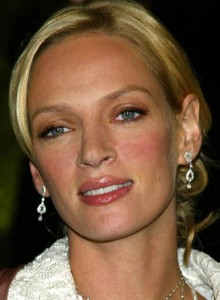
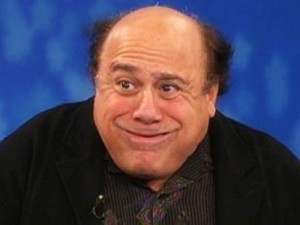
So why do we play lotto? (Please note: I did not ask rhetorically “why do we gamble?” because general gambling is as different to the National Lottery as Uma Thurman is to Danny DeVito. (No offence to either, just two different typos. By the way: I stole these photos off the Internet with no copyright so I may be fined like the Jammie Thomas-Rasset woman who pirated 24 songs and is now to pay $2M.)
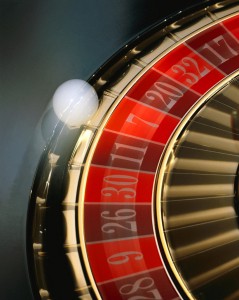
If you want to be in for the big lucky one, go lotto! If you want to stand a chance, go to an honest casino. On Black Jack your chances are nearly 50-50%. On the French Roulette not so good, but a straight bet may win you about $35 for every buck you gamble. That’s more than 100,000 times more likely than winning the big lottery.
This is no promotional stuff for any gambling institution. All gambling is bloody bad (unless you win). Yet winning in a Casino is far more likely and more people do so than on the big lottery stage. However, a BIG win is more attractive because it’s more likely to be a life-changing experience. Be a nice homeless guy, find a coin by the kerb, enter the lotto shop poor, buy a ticket and tomorrow you’ll be a millionaire giving $$$ to charities to keep other people off the street. That’s perfection. Reality is not.
What most people don’t get is that regardless how big the pot is, your chances are just based on how much you spend (how many options you buy). In fact, on a big jackpot you risk more: even if you win, it is more likely that there will be other winners to share the prize with you.
Still remember the insurance business? Your chances to bang into the Pentagon are even smaller than you winning lotto’s first division. What do you want to do? (You don’t have to do anything, yet life is short, thus you’d better spice it up!) I would chose French Roulette (not to be confussed with Russian one).
Meanwhile I’m signing off to go and check my lotto ticket. By the way: guess if I have insured my car?! (Hint: I drive a British red turbo.)